
• Shopping Cart Shopping Cart
    0Shopping Cart
Mission Museum
  • Link to Facebook
  • Link to Instagram
  • About Us
  • Local History
  • Museum Collection
  • Events & Programs
    • Events
    • Children’s Summer Programs
    • Historic Downtown Walking Tours
    • School Programs & Educational Resources
  • Exhibits
  • Get Involved
    • Volunteer Application Form
    • Employment Opportunities
  • Donate
    • Artifact Donations
    • Financial Donations
  • Contact us
  • Click to open the search input field Click to open the search input field Search
  • Menu Menu

The Arrival of the Oblates
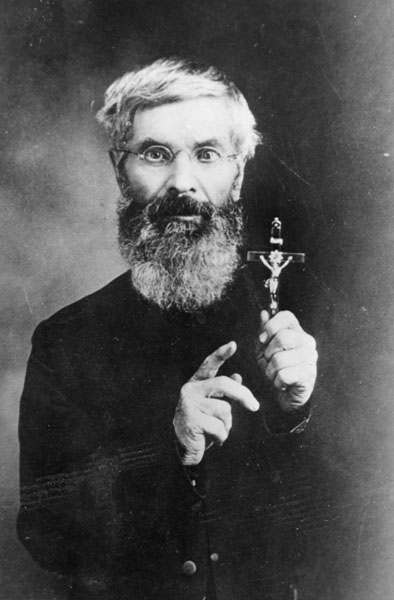
Father Leon Fouquet

The Arrival of the Oblates

One February day in 1861, an iron war canoe travelling upstream on the Fraser River changed the course of history in the Fraser Valley forever. The canoe carried twelve Stó:lō men and one Father Leon Fouquet, the latter of whom had recently arrived from France on a mission for the Oblates of Mary Immaculate. The Oblates were a new Catholic order, originally established to evangelize and educate the poor, who believed that Satan was at work both in the lives of non-Christians, but also in the corrupt civilization of Christian secular society. Father Fouquet’s intent was to save the Indigenous populations from not only Satan, but from the violent and alcoholic excesses of the prospectors looking for gold in the nearby Caribou Gold Rush.
Looking to find a place in the middle of Stó:lō territory where he could establish a Mission School and Church, he found the perfect spot by a creek overlooking the Fraser River and the mountains, approximately at the bottom of modern day Grand Street where the train tracks are situated. Fouquet set to work, building the grounds which he hoped would soon be used to educate local Indigenous boys.
Many of the Stó:lō were initially happy that Father Fouquet had arrived. Full of the best intentions, the Oblate priest genuinely wished to help the Stó:lō Peoples, who were often badly mistreated by the white settlers and gold prospectors. The Oblate settlement was constructed quickly, with the Oblates and the Stó:lō working alongside each other. It included farmland, orchards, a church, several residences, and a grist mill and sawmill. It even included a post office, where mail would be addressed to St. Mary’s Mission. Because there was a similarly named religious settlement in the Okanagan, the post would be addressed to Mission City. By 1863, the boys’ school was running. In 1868, the Sisters of Saint Ann joined the Oblates to establish a nearby sister school for girls.
Some of the Stó:lō became enthusiastic Catholics, finding the rituals of the Church in many ways similar to their own highly ceremonial spiritual gatherings. Enthusiastic re-enactments of Passion Plays depicting the Crucifixion of Christ drew crowds of thousands of First Nations people. At this time, residential schools had not yet been made mandatory nor earned their infamous reputation, and many families wished for their children to be educated by the Oblate Fathers, willingly sending their children to the school. Father Fouquet and at least one of his contemporaries were staunch advocates for respecting Stó:lō land rights.

The Residential School System

In 1883, the Canadian Pacific Railway requisitioned the land on which Father Fouquet built the Mission, and St. Mary’s Mission moved (with reluctance) uphill to their second location in what is now Fraser River Heritage Park. But by the 20th century, many of the school’s methods for governing the Mission were dictated by the Federal government’s policies, which were intended to suppress all First Nations culture with the goal of assimilation via the destruction of their cultures, communities and heritage. Following the establishment of these laws, indigenous children were required to attend residential schools, and were not allowed to see their families for a minimum of six years in the hopes that the absence would break cultural and family ties. They were forbidden from speaking their mother languages, and children were faced with harsh punishment as a consequence if this rule or any other rules were broken.

In 1961, the Oblate school was closed down, and a government-run school was erected east of the second site. By the 1970s, the school buildings were used as a residence for Indigenous students who lived too far away to attend the Mission Public Schools. The residence was closed in 1985, making it one of the last residential schools to close in Canada.

For more information regarding the Residential School System, please explore:  

  • Amongst God’s Own by Terry Glavin
  • Siwal Si’wes Library
  • https://indigenousfoundations.arts.ubc.ca/the_residential_school_system/
  • Truth and Reconciliation Commission of Canada

Get notified about museum exhibits, events and programs!

Like us on Facebook

Events Calendar

Current Month

june, 2026

Search Search

Museum Hours

SUMMER HOURS:

June 18th – August 22nd, 2026

Thursdays – Saturdays
10am – 4pm

Website Privacy Statement
Indigenous Relations Policy

Museum Address

33201 2nd Avenue, PO Box 3522
Mission BC V2V 4L1
604 826 1011

info@missionmuseum.com

GENEROUSLY SUPPORTED BY

The Mission District Historical Society gratefully acknowledges financial support received from the City of Mission, the province of British Columbia and private and corporate donors.

Copyright - Mission Museum - powered by Enfold WordPress Theme
  • Link to Facebook
  • Link to Instagram
Scroll to top Scroll to top Scroll to top

This site uses cookies. By continuing to browse the site, you are agreeing to our use of cookies.

AcceptHide NotificationSettings

Cookie and Privacy Settings


How we use cookies

We may request cookies to be set on your device. We use cookies to let us know when you visit our websites, how you interact with us, to enrich your user experience, and to customize your relationship with our website.

Click on the different category headings to find out more. You can also change some of your preferences. Note that blocking some types of cookies may impact your experience on our websites and the services we are able to offer.

Essential Website Cookies

These cookies are strictly necessary to provide you with services available through our website and to use some of its features.

Because these cookies are strictly necessary to deliver the website, refusing them will have impact how our site functions. You always can block or delete cookies by changing your browser settings and force blocking all cookies on this website. But this will always prompt you to accept/refuse cookies when revisiting our site.

We fully respect if you want to refuse cookies but to avoid asking you again and again kindly allow us to store a cookie for that. You are free to opt out any time or opt in for other cookies to get a better experience. If you refuse cookies we will remove all set cookies in our domain.

We provide you with a list of stored cookies on your computer in our domain so you can check what we stored. Due to security reasons we are not able to show or modify cookies from other domains. You can check these in your browser security settings.

Google Analytics Cookies

These cookies collect information that is used either in aggregate form to help us understand how our website is being used or how effective our marketing campaigns are, or to help us customize our website and application for you in order to enhance your experience.

If you do not want that we track your visit to our site you can disable tracking in your browser here:

Other external services

We also use different external services like Google Webfonts, Google Maps, and external Video providers. Since these providers may collect personal data like your IP address we allow you to block them here. Please be aware that this might heavily reduce the functionality and appearance of our site. Changes will take effect once you reload the page.

Google Webfont Settings:

Google Map Settings:

Google reCaptcha Settings:

Vimeo and Youtube video embeds:

Other cookies

The following cookies are also needed - You can choose if you want to allow them:

Privacy Policy

You can read about our cookies and privacy settings in detail on our Privacy Policy Page.

Website Privacy Statement
AcceptHide Notification
X